Friday, 19 April 2013

Evaluation of my Media Product


 My media product is the production of an extract of a music documentary based on looking at local bands, and how they survive in towns, which are not normally known for producing bands/musicians, or to come from a more creative background. The videos, which were filmed separately to become the extract – showing the basic format for the show, are simply shot, in a documentary style, which means that it is far more realistic, and just presents a snapshot of the bands instead of an in depth look at each bands psyche. It is designed to promote local music in places, which nationally would never be looked at. I wanted the documentary to feel warm, and friendly, something made that way due to the bands themselves (I chose no completely niche bands – trying to keep them broad but still ‘indie’ so that they would appeal to my target audience. The main influence upon my filmmaking was Roger Sargent’s ‘There Are No Innocent Bystanders’.

I think that the influence from his filmmaking style, and the way he presents the subject are visible in my film as well as some of the camera angles he chooses – which for the most part are very simple but from time to time are very interesting (he is a music photographer as well as filmmaker) which makes for a better film. There are also varying other influences in my filming, the narrative and the shots I wanted and to get the look that I wanted I used an 18-55mm lens on my 650D… meaning that I could get shots of either the whole band as they were playing or very intimate shots of only the one parson at a time, or just instruments. This allowed me to draw focus very easily to certain parts of the track visually, and emphasize either the lyrics or the guitar at a time and focus on them singularly.

A series of screengrabs from whilst I was editing:


To keep a certain level of verisimilitude, I always hand held the camera, but mounted on a tripod to give it good weight – and a lower center of gravity meaning there is only slight camera shake which is like someone is stood observing. For filming the drummer however I almost always let the tripod rest because the drums are so stationary I didn’t need to track movement, and it allowed me to take photos as well with my film camera – something that would help as promotional material for the documentary.

 The contact sheet from my film camera at The Warren whilst I was filming
When filming, I did however try to avoid going below 25-30mm because it would lead to wide-angle distortion, obviously something which would not help the realism of the film. Because I was shooting indoors, there wasn’t really enough light for me to have the aperture at anything but its widest – meaning there is very slight bokeh in some areas, obviously something I wanted to avoid because the way it undermines reality of the film – as well though, I didn’t want to use any form of portable studio lighting because it means that I am no longer using the ambient light of the room – something I aimed to do because of the way it brings the audience into the footage more, and makes it feel more and more like they are part of that recording.  I wanted very sharp footage, so shot in full HD (1080p) because otherwise I don’t think the footage would have looked nearly as good – because this standard quality helps the reality of it but as well gives the film a very crisp look, meaning that it also looks far more professionally produced; this did mean that there was far more space taken up so I bought two 32GB Class 10 SD cards to make sure that they wouldn’t write too slowly and also I wouldn’t fill both the cards during filming. Because the low light, I had to make sure that I was at 200/400 ISO, because any higher would mean a vast reduction in the quality of the footage. It was set to 25fps to try and capture as much as much as possible, and making it easier to sync later in post production – especially because I had to get the audio and the video at exactly the same time.

The first thing I did when I started to begin the cutting of the video was to go through the files using RealPlayer; this application allows the large MOV files to be played at real speed, so that I could go through all the files first and check which were usable, then convert the ones I wanted to use to an MP4 file instead – this is smaller whilst also retaining a lot of the image quality. I would then separate and colour code all the video files I had from filming, which meant that I only had to import certain files into Premiere Pro – meaning that I didn’t have to go though all the files within the program, something that was essential making sure it didn’t lag when syncing the video and also meant I knew all the files in one premiere pro file were all for one track, and I could cut and chop them to sync to the timing of the track. Each part of the video was created separately, saved as an mp4 and then brought into one video, rather than all being done at one because it would have made for a far too overloaded timeline.
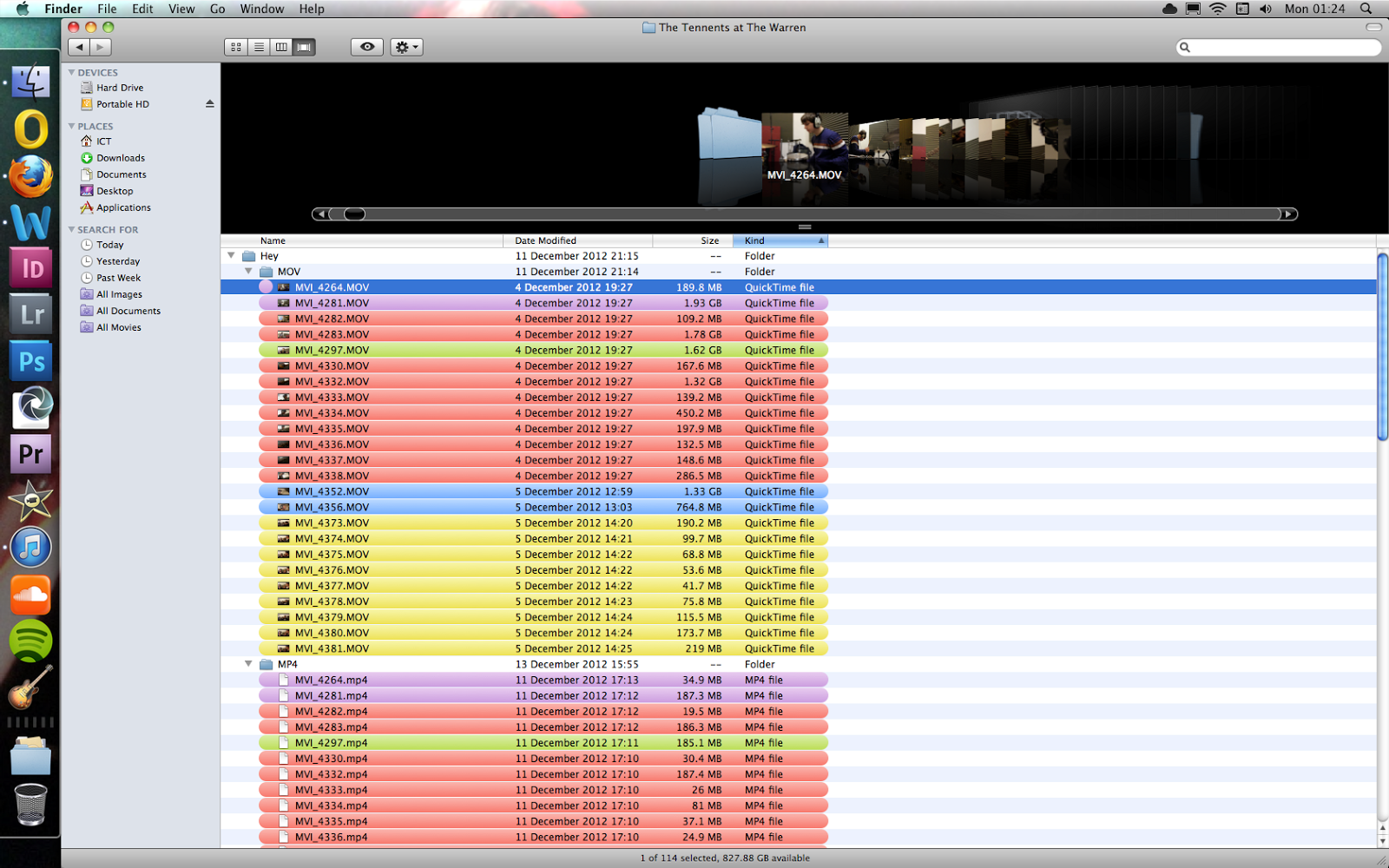
 The folders after they were organized according to what they were of
A print screen from when I was editing using Premiere Pro
 Using the razor tool to cut the interview into sections, allowing me to edit much more easily and cut out anything that was unusable quickly

 Fading the track out before the interview, to smooth the transition between the two items
 
 Because of the wind in the second interview, I had to cut out the bass frequencies in order to get an audible, usable interview

I didn’t want to add too many effects to the video –as then there would be would be a lack of realism and the documentary style of the video would suffer for this; therefore I decided that I should only lighten the video very slightly and also up the contrast – which means that the image doesn’t look too linear and makes it crisper because the dark areas of it are far more impressive too.
In some areas of the final footage I think that there is an element of Jools Holland style band/artist filming, where the camera is completely still but then in others the camera is slightly more jerky and more steady cam, which I think works better because it makes it more personable and intimate for the audience with the band.

 
The Libertines on Later With Jools Holland. 
 

The Vaccines live, filmed by Roger Sargent.

            The ideology behind the documentary was to create a snapshot of a music scene usually overlooked, which I think worked well, because as you can see in the extract it introduces the audience to bands without becoming too in depth that it has no worth to anyone who doesn’t know who they are. The interview acts as a chance for the band to connect with their prospective audience, whilst also talking about their city, and their local music and their own music rather than being an interview which looks at relationships in the band or anything to do with celebrity status which I would like to think appeals to the audience more as it has more integrity than a lot of the other forms of media that introduce new music now. I wanted the documentary to be a simple as possible, so it accessible to anyone and have an ethos behind it that stated it was accessible to anyone, because the documentary came to them – unlike past music showcasing programs like Jools Holland, Top Of The Pops and Old Grey Whistle Test. I wanted my documentary to feel more like The Tube (who once produced a Hull band special) and the film ‘It Might Get Loud’ which brought together Jimmy Page, Jack White and The Edge to talk about their music and their playing.

The Tube: Hull Band Special - the raw, more roughly made documentary style programmes like this give a more DIY feel - meaning that it is actually promoting ordinary bands, rather than trying to create stars.

Later With Jools Holland is shot very smoothly, with complete stage lighting, which seems to almost disassociate the band with the audience, something I tried to completely avoid in my documentary.

New media technology played an essential part in the creation of my documentary – from the filming (as mentioned above) being able to be done on my own camera – which was essential in being able to film in manual and change all the settings myself – meaning that the end results were much better because I was used to handling it, and I was never restricted to when I could film. Digital technology means that it is much easier for anybody to use techniques now for simple photography, filmmaking and design, which would have previously only being available to professionals. For example, a free trial of Premiere Pro meant that I could do all of my editing at home, meaning that I had far more time to edit and thus it was much more efficiently done. New media like YouTube also meant that I could find tutorials on how to use Premiere to do certain things and InDesign (for my double page). This meant that I had a much smoother edit than if I had of done it any other way which was reasonably well put together for a first time editing video. I used InDesign rather than Photoshop for the double page listings because it is better for large amounts of texts, but only really works if you have a good idea of what you want to end up with. Because my double page was based quite rigidly in a formula The Guide uses weekly, I knew exactly how I wanted it to look so as soon as I had put in the photos and text I could tweak to ensure that everything fitted together just right and didn’t look out of place. For the poster I used Photoshop, because it was a very simple design and Photoshop makes it far easier to handle the images that I used. This meant that I could produce materials to at least I think a semi-professional quality because of their simplicity coupled with boldness.

I think that my ancillary texts (the poster and the TV listings double page) conform to the conventions known to my audience – which is what makes them successful counterparts for my documentary.


One of the main ideologies behind the poster was to make sure that it was as simple as possible, which I think makes it a lot more bold - and helps to make it stand out much more especially with the positive balanced on the negative space almost equally. I wanted each of the images to be different (it was also key to try and use different photographers) to highlight that they are completely different bands - something that relates to the broadness of Hull's music scene. 
Although the series is across the UK rather than just based in Hull, the poster references only Hull because I wanted to make sure that they documentary still felt local to each area – rather than being a large corporation-made documentary which would make the series feel like there was no sense of independence – something very important when the main aim of my documentary was to uncover ‘indie’ music in alternative towns/cities.I always knew that my documentary would not be aimed at a mass audience - I think the ancillaries and my documentary reflect this because of their aesthetics and ideology being more alternative and subtle.


It was based on a flyer for Richard Hawley's Hull City Hall gig, and a flyer for The Crookes. Both of these flyers are very simple - with the Richard Hawley flyer being only in black and white with bold white lettering making it stand out; and The Crookes' flyer uses parallel lines in order to break up the flyer and draw focus around certain areas - which I have done with the main title in the poster above. 
I think that my poster breaks the mainstream convention to appeals to a more niche audience - simply because it is more understated than posters usually would be; this also helps to appeal to my niche target audience who like the style of music because it is a more mature subtle/understated design. 
One thing that I would change about the poster is that I would use different photos – I like the top photo because of its neutrality and colours, but I don’t think the three central photos fit together completely. The image of The Talks on the right looks slightly less sharp, whereas the other two are much sharper and use colour more effectively to draw the eye. 


I have placed my double page spread in The Guardian's Guide - a supplement with The Guardian on Saturdays which includes TV, cinema, theatre, comedy and music listings; as well as other articles regarding popular culture. The audience are more mature, and well educated, therefore are more suited towards a music documentary like my own. Because The Guide's listings are national, it also applies to my documentary in that way because it doesn't only cover London - or larger cities in the UK; which would all be featured in the whole series for the documentary.
I wanted my double page to have obvious relation to the poster, otherwise it would mean that they would look completely non related, although at the same time I didn’t want it to be the spitting image of it because it has to look independent and as if it was designed by someone else. Again I wanted the design to be very understated because of The Guardian’s readership being more mature – therefore not needing the same sort of stimulation as a magazine like NME which has a much younger audience.
I wanted the page to be as minimalistic as possible, therefore didn’t bring any completely new colours, and stuck to the black and white classic print apart from the green subheadings. I used green because it the eye is first drawn to the two top left images, both made up of more green which means that the images sit much more nicely and leads the eye across the article, drawing it in more.
One thing that I would change on the double page listings is that I haven’t used a byline/tagline to draw the reader in more straight at the start – although it is hard to see how it would have fitted in without breaking the aim of keeping the page very minimalist and above all else not looking cramped at all.
In conclusion, I think my ancillaries work well because of the way they keep a distinct house style with the fonts used (which are the same as in the actual documentary too) and the colour schemes, which I think creates a cross form synergy when put together. The shared elements between the three texts means that they all work well together – and the audience, viewer or read doesn’t necessarily need to see the title in order to recognise that they are from the same production and that they go together.
I tried to make sure that I used a variety of different photographers images for the double page spread and the poster to ensure that there was a distinct feel between each image to ensure that they were seen as completely unique bands that weren’t necessarily related – part of my underlying ideology to promote music in more alternative places.
            In my audience feedback it was generally said that all three texts work well together, because they have the same ‘feel’ and therefore go together well. It was said that this is mainly down to the choice of fonts and the style of design. The first piece of audience feedback I did was with Laura Jenkinson, and it was a broad interview about music documentaries, this audience feedback gave me what sort of audience I need to aim for, as well as key parts of the documentary that I needed to focus on. As my main influence on the documentary was ‘There Are No Innocent Bystanders’ by Roger Sargent, the key part of the interview was to do with the film’s trailer and how they thought it worked well or not. 


I then went on to use questionnaires rather than filming, as it meant there was less time preparing and uploading and it allowed the participant to complete it in their own time, whilst watching the trailer or my documentary. I then turned these questionnaires into GoAnimates:


Audience Feedback 1 by Wes Foster on GoAnimate with Joe, an avid music lover who was in various bands whilst The Libertines' made indie popular as a genre


  Audience Feedback 2 by Wes Foster on GoAnimate with Linda Johnson, who likes various music and watches shows like Jools Holland often. 


As can be seen from the above interviews, most of the reactions to my documentary were positive, and for the first drafts seemed to say that the camerawork was good – and the editing works for the tracks, but the video needed to be cut down a little because it was too long, and because disinteresting. Another common flaw was the first interview, which had to be redone anyway because the sound had completely not worked – plus with two subjects it was hard to get them to say enough for the interview to really say something. Therefore I used the introduction with both the drummer in The Tennents, Sam Mackereth and the guitarist Matty Connor. Then after that I only used segments I did with Matty at a later date. Even though the sound quality still wasn’t anywhere near perfect because of the wind (I was using a hotshoe mic) it worked far better than the original interview, although when the mic was on top of the camera most was lost, whereas when it was held in hand it work to a good standard. For the documentary I didn’t want a ‘perfect’ quality interview, because it wouldn’t really fit with the rest of the camerawork, which is at times scrappy and a little shaky; although I think this adds to it and gives it more character, rather than being filmed completely smoothly like most music TV shows do, for example Later With Jools Holland and so the more raw filming works well in my documentary I think, and makes the video slightly better for it – therefore if the interview was perfectly shot, it would not have suited aesthetically to the rest of the documentary and the DIY feel I think it creates; something very important in my documentary because of two things - making sure it had strong ties to the 'indie' theme, which is rooted in punk and DIY as well as making sure that everything which I shot felt independent, rather than something commercial and manufactured.

The final extract from my documentary -

This is the final extract from my documentary, shortened after the last draft and with part of a new interview.

Sunday, 7 April 2013

My magazine double page, for The Guardian's Guide


--> I have placed my double page spread in The Guardian's Guide - a supplement with The Guardian on Saturdays which includes TV, cinema, theatre, comedy and music listings; as well as other articles regarding popular culture. The audience are more mature, and well educated, therefore are more suited towards a music documentary like my own. Because The Guide's listings are national, it also applies to my documentary in that way because it doesn't only cover London - or larger cities in the UK; which would all be featured in the whole series for the documentary.
I wanted my double page to have obvious relation to the poster, otherwise it would mean that they would look completely non related, although at the same time I didn’t want it to be the spitting image of it because it has to look independent and as if it was designed by someone else. Again I wanted the design to be very understated because of The Guardian’s readership being more mature – therefore not needing the same sort of stimulation as a magazine like NME which has a much younger audience.
I wanted the page to be as minimalistic as possible, therefore didn’t bring any completely new colours, and stuck to the black and white classic print apart from the green subheadings. I used green because it the eye is first drawn to the two top left images, both made up of more green which means that the images sit much more nicely and leads the eye across the article, drawing it in more.
One thing that I would change on the double page listings is that I haven’t used a byline/tagline to draw the reader in more straight at the start – although it is hard to see how it would have fitted in without breaking the aim of keeping the page very minimalist and above all else not looking cramped at all.


Friday, 5 April 2013

Poster For Documentary


One of the main ideologies behind the poster was to make sure that it was as simple as possible, which I think makes it a lot more bold - and helps to make it stand out much more especially with the positive balanced on the negative space almost equally. I wanted each of the images to be different (it was also key to try and use different photographers) to highlight that they are completely different bands - something which relates to the broadness of Hull's music scene. 

It was based on a flyer for Richard Hawley's Hull City Hall gig, and a flyer for The Crookes. Both of these flyers are very simple - with the Richard Hawley flyer being only in black and white with bold white lettering making it stand out; and The Crookes' flyer uses parallel lines in order to break up the flyer and draw focus around certain areas - which I have done with the main title in the poster above. 


I think that my poster breaks the mainstream convention to appeal to a more niche audience - simply because it is more understated than posters usually would be; this also helps to appeal to my niche  target audience who like the style of music because it is a more mature subtle/understated design. 


Friday, 22 March 2013

The last draft extract for my documentary -

This is the last draft for my documentary. The interview (sound wise) did not go as well as planned, although I think the framing worked well, as did the answers (when they can be heard) I want to also cut down the extract from nine minutes to around five; so that nothing gets lost because of the length.

Friday, 14 December 2012

The Tennents - Hey (Working Title)

This is the first edit of The Tennents - 'Hey' (Working Title). There are a few little edits that need to be ironed out, and some camera movement which needs to be replaced with something else before it is fianlised; but I do think that overall it works and capture the lively feel which I wanted for the recording parts of the documentary.

At the Warren The Tennents were originally going to only be recording two songs - 'Touch The Sky' and 'I've Been Waiting' but they also recorded this track, 'Hey'. I have decided to use a sample of this video as the first track on the documentary because of the introduction - which is longer and will therefore stretch over the opening titles, instead of having no sound at all. The downfall to using this track however is that I have less even footage - i.e. not all the members of the group share a similar time in the video because of battery running out, or the memory card unable to carry more as I had only planned for two tracks. Over the two days at The Warren I shot around 40GB of footage because I was shooting in full HD (1920 x 1080) because if the quality wasn't good then the documentary would loose a lot of versimilitude It would also mean that the little focusing tweaks through the video would not be noticable due to the quality and I think that these work well - making the shots more interesting whilst also making the subject more intriguing.

I editied the whole piece of footage in Adobe Premiere CS4 after going through the clips in RealPlayer choosing which were usable and which had to be scraped - or at least put in a miscellaneous folder. In Premiere I cut the clips and placed them in the order I wanted them to appear in then put up the brightness and contrast to realistic levels so that the lights look right to our eyes because I think the ISO on the camera was a little sensitive with the aperture. Other than that I didn't add any other effects to make it better quality - I wanted it to be as close to how it was shot as I could possibly; which I think makes the footage more point of view and as if the viewer/audience was actually there.

For the actual documentary, only around 30-40 seconds will be used rather than the whole video - otherwise the documentary would seem very dull and repetitive for every band shown. Instead I want to make sure that every video is just a taster of the band - therefore showcasing the musicians around Hull much better. This means/encourages the audience to listen to and remember the band later because they haven't heard all of the track - therefore meaning that the documentary is doing what it is supposed to; presenting a snapshot of loac bands.

Tuesday, 11 December 2012

Recording Photos


The Warren Records

Warren Records started up in September 2009 with a release of 'State of The City'. The label is a branch of The Warren, a charity organisation set up in Hull to support young people; the records branch of the charity was set up after 'Secret Millionaire' Martin Stamp donated £20,000 to songwriters Jody Mckenna and Keith Hagger who then set up the recording rooms in The Warren.

'State of The City' is a 41 track showcase of bands from in the city; covering a wide range of genres and styles to try and really put some of Hull's musical talent on the map - aiming to get Hull bands heard of around the rest of the country.

Some of the bands included - The Paddingtons, EndOfLevelBaddie, The Notebook, Novocaine, Counting Coins, Abbie Lammas and more...

Disc 1 -
1. SubSubSub - Resin vs James Pyke Mr Covo
2. Somewhere In This World - The Holy Orders
3. Turn World Around - Ras Greg
4. The Howling - Jody McKenna
5. Been in Love - Nightfall Feat Mr. Prez & Alexis
6. Running Out Of Laughter - The Talks
7. Moto - Hekima & The Bongo Flava
8. Smile - Abbie Lammas
9. I Remember - Tyler Morgan feat Mr. Prez
10. Can't Ruck With Us - Project Feenix
11. Live Fast, Die Young - Keith Hagger
12. Plastic Toy - Sara Sanchez
13. Razor - Novacaine
14. Rupert The Bears On Crack - The Ruperts
15. Vehicastra - Morningstar Productions
16. We Livin - James Pyke & Ysabelle Wombwell
17. Pem Bile Giyane - Dilzar Shanga
18. Only You - Luke Keegan
19. Bang - Mr. Beasley
20. Counteract - The Neat vs. Mr Beasley

Disc 2 -

1. No Mundane Options - The Paddingtons
2. Wonderful Woman - Keith Hagger
3. Line Of Poverty - Kill Youth Culture
4. Real Rap - Grey
5. Break Apart - Storm The Banquet
6. Natural High - Nightfal vs. Y.P.
7. Second Guessing - The Cliques
8. Crazy Show - EndOfLevelBaddie
9. Eves Of Green - Someone & The Somethings
10. Bending Reality - Jody McKenna
11. Bank Roll - Asteroidboyz
12. Eat Your Greens - Counting Coins
13. Falling - Ysabelle Wombwell
14. Whatever It Takes - Outspoken Silence
15. Crystals Of Pyrite - Mountain Goat Frenzy
16. Falling - Ysabelle Wombwell
17. What We Gonna Do - Rad Greg & Ysabelle
18. New Ending - The Notebook
19. Going Sailin' - Joe Duncan
20. Bison - Awash With Antler
21. March Of The Lords - Morningstar Productions

The Warren currently record bands for free - then release the single through SoundCloud for free too, in order to give the band more of a coverage and so that bands can get gigs or send demos.

The Warren have also released Eps/albums from these bands -
Outspoken Silence
Ysabelle Wombwell
Jody McKenna
Hekima & The Bongo Flava
The Talks
Counting Coins
Mootzoot

The Warren will be an important part of the documentary - not just because multiple bands that I am covering have recorded there but also because it is an integeral part of the Hull music scene. I may even get interviews later on with Stuart Baxter - the sound engineer and one of the managers there or others that work within the Warren Records sector of The Warren. These interviews would offer an alternative view to the music scene at the minute in Hull - other than just interviewing bands. These interviews would also show what someone with real experience - and encounter a lot of local bands daily seeing how the areas taste and styles change over time; therefore they are more likely to give me a more conclusive answer than any currently popular band at the minute. This is not something I would film just yet however, as I think it is more important to record and talk to the bands first as they are the ones who are going through - or at least a bigger part of it.

Monday, 10 December 2012

Band Profile - The Tennents

The Tennents are a rock quartet from various villages around Hull. Having formed only a year or so ago, they are an already well established live act in the city - regulars at Lamp, Fruit and other pubs and clubs around the city. they have also featured in the now Fuel based indie themed night 'Time For Heroes vs Bossanova' - a culmination of two exciting nights after Lamp had to shut its doors for the final time.
Their sound is a mixture of classic rock with undertones of the nineties grunge movement - somewhere between Peace and The Enemy with clever lyrics and great guitar riffs. For such a young band their lyrics are suprisingly clever and work well - giving the songs not nescessarily more depth but still something with more soul than your average pop song. This form of lyric writing - especially caring about what you right isn't seen in a majority of rock bands and lyrics are generally more pompous, egotistical and have no sense of reality. Matty Connor, the lyricist, is no Doherty, Turner or Dylan yet but there are signs that he may develop into an even better songwriter than he already is.

The Tennents have recently been recording their first Ep at The Warren and is set to be released and heavily promoted by Jigsaw Records - a local, independent records company - in the coming months.
At least two of the tracks from the Ep will be featuring in the documentary with the segment about them.
The Ep tracklist:
1. Touch The Sky
2.I've Been Waiting
3. Hey (Working Title)

Members -

Matty Connor - Lead vocals/lead guitar
Sam Mackereth - Drums
Ryan Smith - Rhythm guitar/backing vocals
Barney Wilson - Bass/backing vocals

(At time of writing)
Twitter followers: 446
FaceBook likes: 185
Soundcloud: 0

Reverbnation stats -
Rank: #15 (The rank is how popular they are in their area, which is listed as Withernsea)
ReverbNation fans: 4
Video plays: 128
Total Fans (ReverbNation/FaceBook): 189

YouTube:
Subscribers to the bands channel: 15

'Exits on the Left': 910 views
'What To D'o: 1,085
'Wait & See': 232

2,252 YouTube views in total.

'Exits on the Left' YouTube statistics - 

910 views since February 2nd
7 Comments
11 likes
0 Dislikes

Top Locations - UK, Ireland, Norway
Top Demographics - Female, 13-17 years; Male, 18-24 years; Male, 13-17 years


'What To Do' YouTube statistics -

1,087 views across since February 2nd
11 Comments
17 Likes
2 Dislikes

Top locations - United Kingdom; Italy; Norway
Top Demographics - Male, 18-24 years; Male, 13-17 years; Female, 13-17 years

Fruit also uploaded an acoustic version of 'Ain't Life Grand'

1,103 views across since May 3rd
2 Comments
13 Likes
3 Dislikes

Top Locations - UK; Norway; Malaysia
Top Demographics - Male, 13-17 years; Female, 13-17 years; Male, 18-24 years


Monday, 3 December 2012

Test shots for microphones (built in and shotgun)

Built in Camera mics
Didn't work because the microphone jack was still in.
Hotshoe Shotgun Mic
Fairly clear left channel - right channel static.
Handheld Shotgun Mic
Clearest with the least static or feedback.
Built in mic
Clear but pics up a lot of other noise - there are two clear channels though.
Hotshoe shotgun mic
(Same as test two)
Clear left channel but static/feedback on the right channel.
 
After these tests I have decided to use the hotshoe mic, however with it mounted rather than held because even though when held it is clearer there is not a long enough lead in order to conduct a group interview effectively. Mounted on the hotshoe it will pick up enough usable sound - and I can then just use one channel rather than stereo, and later spread it across both channels for much clearer sound. 


Interview with Laura Jenkinson about music documentaries


Wednesday, 28 November 2012

Storyboard 4 - Live Recording


Storyboard 3 Interview


StoryBoard 2 - Studio Recording


StoryBoard 1 - Full Plot


Interview Questions first draft


Who are you? (Introduce yourself) Where do you come from? 
·       Where do you fit in within the Hull music scene?
      What do you want to achieve?
      Why did you start the band?

Who influences you in Hull?
      Who influences you outside of Hull?
      Are there any bands you model yourself on or want to emulate? 
      Is music important in Hull?
 

What do you think of the music scene in Hull?
      Do you think music in Hull is getting better or worse?
      What do you think of the bands in Hull at the minute?

How easy is it getting gigs in Hull?
      Are the audiences in Hull good?
      Do you have a fan base?

Have you tried gigging anywhere else yet?.. ( What was it like?)
      Are there any ways for you to get gigs anywhere else? (or how did you start gigging outside of Hull? 
      Where else would you like to be able to gig? Will you soon?

Is this your only source of income?
      Do you have other jobs too?
      Do you live just off the band/gigging
      What do you see yourselves doing in five years time?

What do you enjoy the most about being a band in Hull?
       Is gigging around Hull enjoyable?
       Is the city a big part of your identity?

What do you think of the venues in Hull? Are there enough?
       Is there a gap in the market for better/more venues?
      What else can the venues do to make a better nightlife/scene around Hull?

Anything else to add?/Mention?

Recorded Interview Techniques


For all of my filming I will be using my SLR, this means that the frame size will be consistent and always the same quality. The camera will be sat on a tripod to the right of where I am sat, with the band sat opposite me. The camera will not be dead center in order to try and give the shot more perspective and therefore meaning that the audience feels as if the band are talking to them. There will be a slight gap in between the two musicians (rule of thirds) so that it is not too cramped. One will be slightly further away from the camera than the other is, which means that the recording has some perspective. I am going to always use a tripod so that the camera is always stationary and means that the audience are part of the group rather than a mobile camera, which is always changing shot, would distract from the conversation. The interviews will take place with two members of the band rather than the full band – meaning that the shot is not overcrowded and that they are less likely to talk over each other.
            For sound I will be using a hotshoe mic – meaning that I don’t have to edit the sound with the video later on and therefore it will be of higher quality. The lens used will be a 28mm Wide Angle fixed zoom lens with no autofocus which allows me to frame the band more easily and record silently because the lens has no motor – and will not be constantly trying to focus. For my live and studio recordings I will be using an 18-55mm autofocus/zoom lens instead because I don’t have to think about the sound and also it gives me more range for the filming. For the interviews my aperture will be set to the largest (2.8) because the Auto ISO can darken it later – if I was to lighten it later there would be visible noise.
            The questions will be emailed to the bands before the interviews – allowing them to familiarize themselves with the questions and allowing them to prepare so that they at least have an idea of what they want to say. I will also carry a printed version of the questions for the bands to look over before hand if they need to.
            Each question will be asked in three different ways – with slight variations meaning that I am definitely going to get an answer for every question – and that it will be more in depth than just whatever sprang to mind when it was first asked. It also means that during the editing process I will be able to fit the answers together better – thus giving the documentary a better narrative style – or a more interesting snapshot into the Hull music scene.